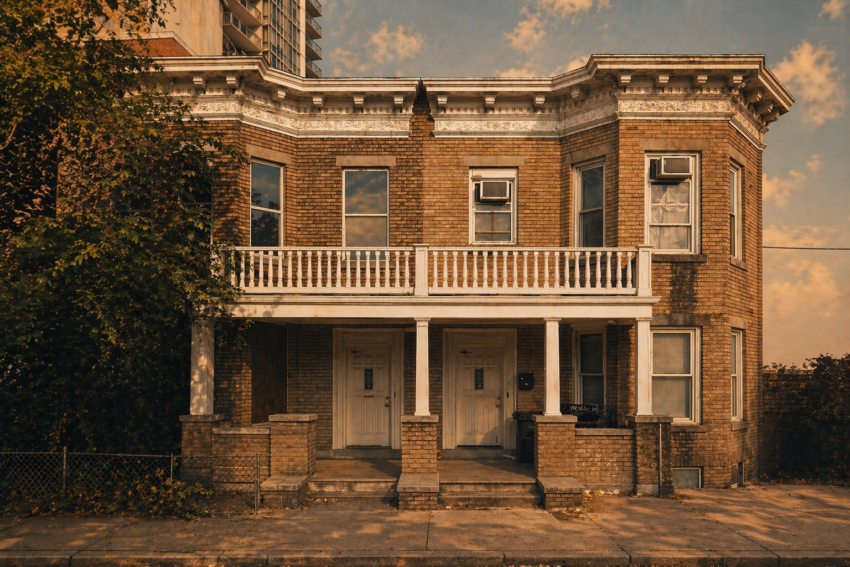
When I think about home, I do not think about an address, although I still remember the exact address that sits quietly within my mind and heart. 1527 Voorhies Ave., Brooklyn, NY 11235.
I think about that two-story single-family house on Voorhies Avenue in Sheepshead Bay, Brooklyn. It was roughly 1976, and it was the upstairs apartment my family rented, living above an older couple who were to be our landlords. Out of all the places my family moved to while I was growing up, that apartment is the one my heart still returns to.
It is the place my eight-year-old self still carries.
It held some of my happiest memories. It also held the moment my world quietly changed forever. And this was also the home where my abandonment wound initially took root based on my surprisingly photographic memory.
Even now, I can walk through that apartment in my mind with a clarity that surprises me. To my eight-year-old mind, it never felt like an apartment. It felt big and safe and permanent, like the kind of home children believe will always be there. Besides, what eight-year-old truly understands the difference between a house and an apartment? That Voorhies Avenue apartment was that little girl’s home in every sense of the word.
Upon entering the house, the heavy wooden front door opened into a small entryway. The landlords’ apartment was immediately on the left, and straight ahead was another door leading to a full flight of stairs up to our apartment. Those stairs always felt so enormous to me when I was little. I climbed them so many times as a child that even now I can still feel them beneath my feet.
At the top of the stairs was a small foyer, the true entrance into the map of my childhood. From there, the rest of the apartment opened around me piece by piece. On the right side was a coat closet, and hanging on the door was a long, full-length mirror. I must have looked at myself in that mirror a thousand times without understanding what I was really looking for.
Directly across from the coat closet was my brother’s bedroom, with a window overlooking our balcony. His bed sat in the far right corner of the room beside the window, and in front of it was his toy box shaped like a large drum, something that always reminded me of the drum from March of the Wooden Soldiers.
My brother and I spent so much time in that room. One of our favorite games was pretending we were Abbott and Costello driving in a car, inspired by the old movies we watched together. He would sit on the edge of his bed while I sat on top of the drum-shaped toy box holding a small frisbee like a steering wheel, pretending I was driving while my brother sat beside me as the passenger.
We were supposed to take turns being the driver, but even back then, I always wanted to be the one behind the wheel. Whenever it was my brother’s turn to drive, I somehow managed to cut his time short so I could reclaim my seat with the frisbee in my hands. It eventually became one of those family jokes we still laugh about today.
Next to his room was the living room, where my brother and I spent Saturday mornings in the 1970s sitting at the coffee table with bowls of cereal while cartoon theme songs filled the air and sunlight drifted through the bay window. It was the kind of ordinary childhood magic you do not realize is magic until decades later.
The living room always felt enormous to me when I was little. Looking back now, I know it probably was not as large as it felt then, but to my eight-year-old self, it felt as enormous as Madison Square Garden. As you walked into the living room, immediately to the left was the large wooden entertainment center and bookcase my father built with his own hands that he bolted to the wall. It held our turntable, where Donna Summer, Cat Stevens, CCR, the Four Seasons, and countless Motown artists, often played through the apartment, becoming part of the soundtrack of my childhood.
Straight ahead was the white aluminum storm door leading out to the balcony, with a black decorative emblem on the front. Behind it was a screen door that let fresh air drift through the apartment during the warmer months. To the right of the balcony sat a large recliner chair, and beside it was the round wooden side table with that awful 1970s lamp. Next to, and slightly behind the recliner, there was a beautiful large bay window filled with my mother’s houseplants soaking up the sunlight that poured into the room each morning.
From the large bay window to the right, against the far wall toward the back of the room, sat our large tweed sectional couch in shades of brown, cream, and gray. In front of the couch was the long black slate coffee table with heavy dark wooden bases on each end. Sitting on that couch, you could look across the room and see my father’s wooden entertainment center and bookcase against the opposite wall. To the left of the couch was the large archway leading into the dining room, and beside the archway sat our television directly across from the old recliner chair.
Beyond the archway was the dining room, which could also be entered directly from the foyer, adding to the open feeling of the apartment.
If you turned right from the foyer, the hallway led deeper into the apartment, opening up the rest of my favorite childhood home, piece by piece.